
From predictive inventory to robot deliveries, technology is reshaping the hospitality industry – but the human touch remains irreplaceable
“AI, automation, and algorithms. The kitchen’s getting smarter. What a boring subject, eh?” quipped moderator Tapan Vaidya, Treasurer of UAE Restaurants Group & CEO of PJP, as he opened what would prove to be anything but a boring discussion. The industry panel brought together a diverse group of experts, each offering unique perspectives on the technological transformation reshaping restaurant operations.
On the panel of experts were:
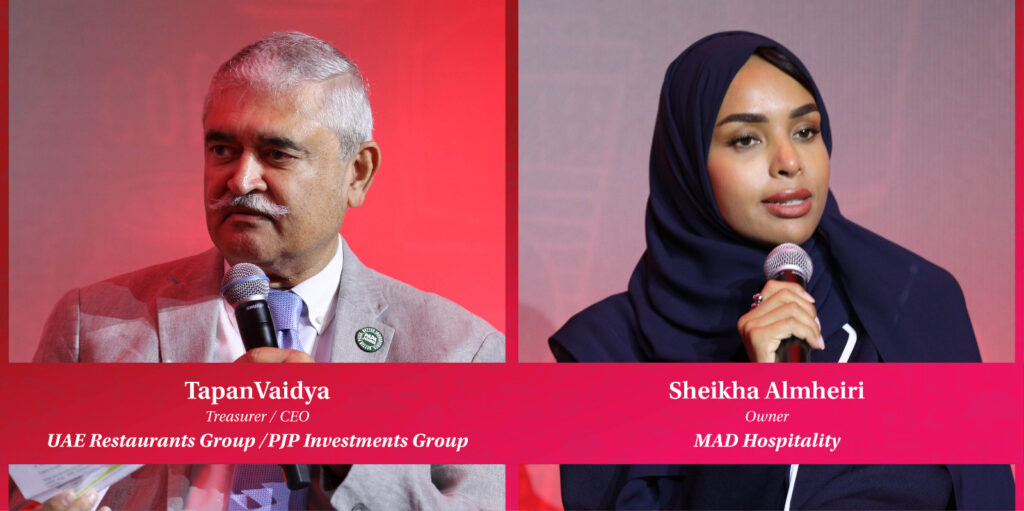
Starting strong, Sheikha said, “Technology is actually intelligence, it’s an enabler, it’s decision making, and whatever we try to use technology for, it’s to actually simplify our day-to-day, our decision-making ability, our management, our profitability.”
George added, “Technology can improve efficiency and enable our team to work faster, better, and in a sustainable manner. The restaurant chain has undergone a dramatic transformation over recent years, moving from taking orders on kitchen order tickets, notepad and pencil to implementing a comprehensive tech stack including POS systems, kitchen display monitors, and predictive inventory management.”
In the hospitality industry, particularly in kitchen operations, skilled labor shortage represents one of the most pressing challenges. “Skilled labor is very difficult to come by, and even if you do, holding on to them is an even bigger challenge,” explained George.
The solution lies not in replacing human workers but in optimising their capabilities. By automating backend processes and mundane day-to-day tasks, restaurants can empower their teams to focus on higher-value activities – creating memorable customer experiences rather than managing repetitive administrative work.
Elucidating the difference between traditional and smart kitchens, he said, “The transformation represents another fundamental shift in operational philosophy. Traditional kitchens operate reactively: something broke down, then I took action, or “we had too many orders, we ran out, next week we’ll try and fix it.”
Smart kitchens, powered by IoT sensors, predictive analytics, and AI-driven equipment, enable proactive management. Restaurant teams can anticipate guest expectations and manage backend workflows more efficiently, allowing front-line staff to concentrate on what they do best: creating unforgettable dining experiences.
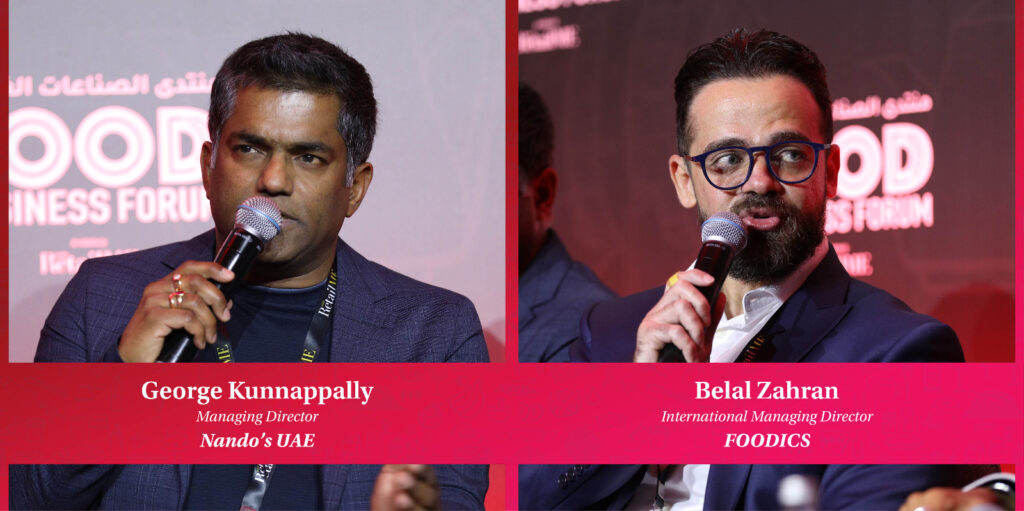
One of the most compelling applications of AI in restaurant operations is predictive inventory management. Belal explained the challenge: “One of the biggest challenges in the F&B industry is the matching between supply and inventory.”
AI addresses this by analysing multiple data points – sales history, seasonality patterns, and stock availability – to predict business behaviour accurately. The results are impressive: some restaurants have achieved up to 25% reduction in waste by implementing AI-driven inventory systems.
“This means better financials, better cash flow, and most importantly, sustainable operations,” noted Belal. “Whatever we are providing is always relating to the customer experience, and sustainable operations directly impact customer experience.”
The true power of predictive analytics became evident during the COVID-19 pandemic. As Anand recounted, a major US bakery using conventional inventory methods found their reactive approaches went for a toss when the pandemic hit. However, businesses using AI-driven tools with real-time information processing were able to adapt proactively to unprecedented circumstances.
The key lay in gathering multifaceted data – from seasonality and inventory patterns to sales trends – and using that information to automate decision-making processes that avoid food wastage, decrease costs, and optimise inventory levels.
Beyond inventory management, AI applications extend to store loss prevention, which is a critical concern for retail businesses. Rupam pointed out that damages and shrinkages can account for up to 13% of total inventory in some operations.
“When I say AI, we need to understand one important thing, I’m not talking about any generative AI or deep learning methods. I’m talking about pure machine learning models. It’s very simple, mathematical, statistical,” he clarified, adding, “The practical application involves processing transactional data to provide insights every 10-15 minutes about what’s selling, what’s not moving, and how to replenish immediately. This approach has been successfully implemented in fashion retail and shows significant promise for food businesses.”
Moving on, the panel revealed that AI’s potential in menu development and customer customisation requires substantial historical data to be effective. As Sheikha explained, “AI is supposed to assist how we think, the way we approach things, and consolidate and create correlations for historical and future behavior forecasting.”
The key is connecting all business touchpoints.”If your systems are not speaking to each other, if the AI is not assisting you to connect all of these points in real-time, then you’re late,” she emphasized.
This holistic approach recognises that modern consumers actively communicate their preferences, making it challenging for restaurants to dictate offerings. Instead, successful operations must listen, analyse, and respond to customer signals through integrated technological solutions.

A key insight on the panel concerned supply chain intelligence, which leverages technology to create unprecedented transparency. As Anand described, “We provide traceability from farm to fork. Right from the farm to the fork, we provide traceability in terms of what products are going into a specific dish.”
This system enables restaurants to provide detailed information about ingredients, crucial for customers with allergies or specific dietary requirements. A simple scan can reveal the complete composition and origin of any dish, enhancing both safety and customer confidence.
The integration of POS systems with supply chain management creates a seamless flow of information. Furthermore Belal explained, “We are connecting the POS with the supply chain management systems, which means they’re linked together, talking to each other.”
This connectivity enables restaurants to track ingredients from farm to kitchen, estimate delivery times accurately, deal with pricing changes proactively, and predict supply chain behavior. The result is improved customer experiences and more efficient business operations.
IoT sensors play a crucial role in this ecosystem, particularly for perishable goods. Real-time temperature monitoring ensures food safety compliance while providing data for optimization algorithms.
When considering technology investments, restaurant owners emphasised looking beyond the initial purchase price. Sheikha emphasized the importance of scalability, “Whatever technology you develop or purchase today should be able to integrate with whatever stream of business you want to take, whether you’re doing ghost kitchens or pop-ups.”
The technology must adapt to business growth without requiring complete system overhauls. “You need a system that can develop as quickly as you need to develop and deploy an experience or a product,” she noted.
As Anand explained, “If our technology doesn’t provide a framework to integrate effortlessly with existing systems – be it POS, be it your backend inventory management systems – then the amount of work you need to put in to integrate becomes a very arduous task.”
The key is selecting technology partners who prioritize integration frameworks that minimize implementation effort while maximizing data utilization for meaningful business decisions.
Perhaps the most critical aspect of technology adoption is managing the human factor. Sheikha identified this as often the most overlooked consideration. The complexity of new systems can create frustration and resistance among staff.
“The question when we invest in technology is: how easy can our team adopt it, and will they champion it or resist it? Because that’s the biggest ROI,” she added.
George also addressed a fundamental concern: the fear that automation will eliminate the human element from hospitality. “Thanks to decades of science fiction movies, there’s a general perception that automation is going to take away jobs, get rid of the human element.”
However, the reality is more nuanced. “Hospitality is more about building relationships, creating emotions, and these can’t be done by automation. Automation works with logic and data, but intuition and emotion are not data-driven.”
The goal is to use automation to increase human capacity rather than replace it. “Automation should augment the human element, not be seen as a disruptor, you still need trained employees who can offer thoughtful suggestions, read a customer’s mind, or provide a genuine smile,” George explained.
Real-world examples support this perspective. Robotic cafes, despite initial social media attention, haven’t achieved lasting success. As Sheikha observed, “Nobody engaged with these cafes. They’re not trending, they’re not cool. Hospitality is a place of communion, where people gather to meet, network, to be human.”
The next topic on the panel revolved around sustainability. It was agreed that beyond waste reduction, AI can contribute to broader sustainability goals by controlling and predicting consumption patterns.
Sheikha explained, “Restaurants can use predictive analysis to understand exactly what they need, when they need it, and how they need it. This creates sustainability throughout the food chain, though the transformation will require time and collaborative effort.”
“If people within a country or city want to reach sustainability, they need to be able to predict so everyone works together,” she noted. The goal is eliminating reactive purchasing, no more calls from suppliers offering discounts on excess inventory.
The practical application of restaurant technology extends beyond kitchen operations. Tapan revealed that Papa John’s has pioneered robotic delivery in Dubai’s Serena development, using autonomous vehicles equipped with cameras, radar, transponders, and GPS capabilities.
These pizza-box-sized robots navigate safely to customers’ homes, where a password-protected system enables order retrieval. The technology demonstrates successful integration where it adds genuine value rather than existing for novelty’s sake.
George advocated a systematic approach: “Identify your pain points first before you decide on the tech stack. Don’t get onto the technology bandwagon to tick a box or join the gang.” Forward-thinking entrepreneurs should invest in solutions that can grow with their business vision, avoiding costly system replacements as they expand.
Sheikha recommended a contrarian approach: “Start simple and start small, and outgrow the technology rather than invest ahead, because technology gets outdated extremely fast.” This philosophy prioritises control and gradual adoption over expensive, complex systems that may become obsolete quickly.
Rupam emphasised the importance of data preparation: “Between team and technology, there is one more layer called data. Historical data, understanding use cases, defining use cases – then move to the technology stack.”
Belal positioned technology as an essential business ally: “For any restaurant owner, technology should be your best friend because you are doing business for money, and technology gives you the ability to understand your business behavior so you can take smarter decisions.”
As the industry continues evolving, the restaurants that thrive will be those that view technology not as a replacement for human expertise, but as a powerful tool to unleash their teams’ creative potential. The smart kitchen revolution is not about replacing chefs with robots – it’s about empowering culinary professionals to focus on what they do best: creating moments that bring people together around great food and genuine hospitality.



Watsons to open 20 new stores in the GCC
In 2020, global health & beauty retailer AS Watson Group signed its
April 29, 2024 | By Rupkatha BAsda and Deliverect Deepen Partnership to Power Rapid Delivery Across Asda Express
SQUATWOLF’s Kuwait Flagship Store Anchors Its Regional Growth Ambitions
/ 
For decades, Haldiram’s built deep recall across the UAE through its packaged

When House of Habanero opened its first physical location at Alserkal Avenue

Union Coop has completed a significant expansion of its Hatta Souq branch,

Saudi Arabia is set to welcome U.S. food exporters this week, as

Majid Al Futtaim has officially entered the discount retail segment with the

As convenience increasingly becomes currency in the region’s grocery landscape, Union Coop

As wellness becomes a lifestyle in the UAE, the grocery aisle is

Grandiose, one of the leading grocery retailers in the UAE with a

With shifting consumer behaviour, rising cost pressures, regulatory changes, and rapid digitization,

Union Coop’s blend of retail expansion, digital innovation, and community focus is

Abu Dhabi-based MAIR Group has marked a pivotal stage in its transformation

In a move that blurs the line between shopping and investing, Apparel
/ 
Tableside theatre, burrata cracked over butter chicken, a Laal Maas Cigar —
For decades, Haldiram’s built deep recall across the UAE through its packaged

In hospitality, brands are often discussed as concepts. But the strongest ones
At Souk Madinat Jumeirah, with the Burj Al Arab rising quietly in

Keto Kartel has entered the UAE’s premium wellness food space at a

With at least seven stores now operating across the country—mainly in Dubai,

The UAE Restaurant Group (UAERG), the official representative body of the country’s
As one of the world’s largest pizza chains, Little Caesars is making

Experiential dining has transformed the restaurant industry inculcating multi-sensory gastronomy to Instagram-worthy

The food service industry in the Middle East is being ushered into





 Previous Article