

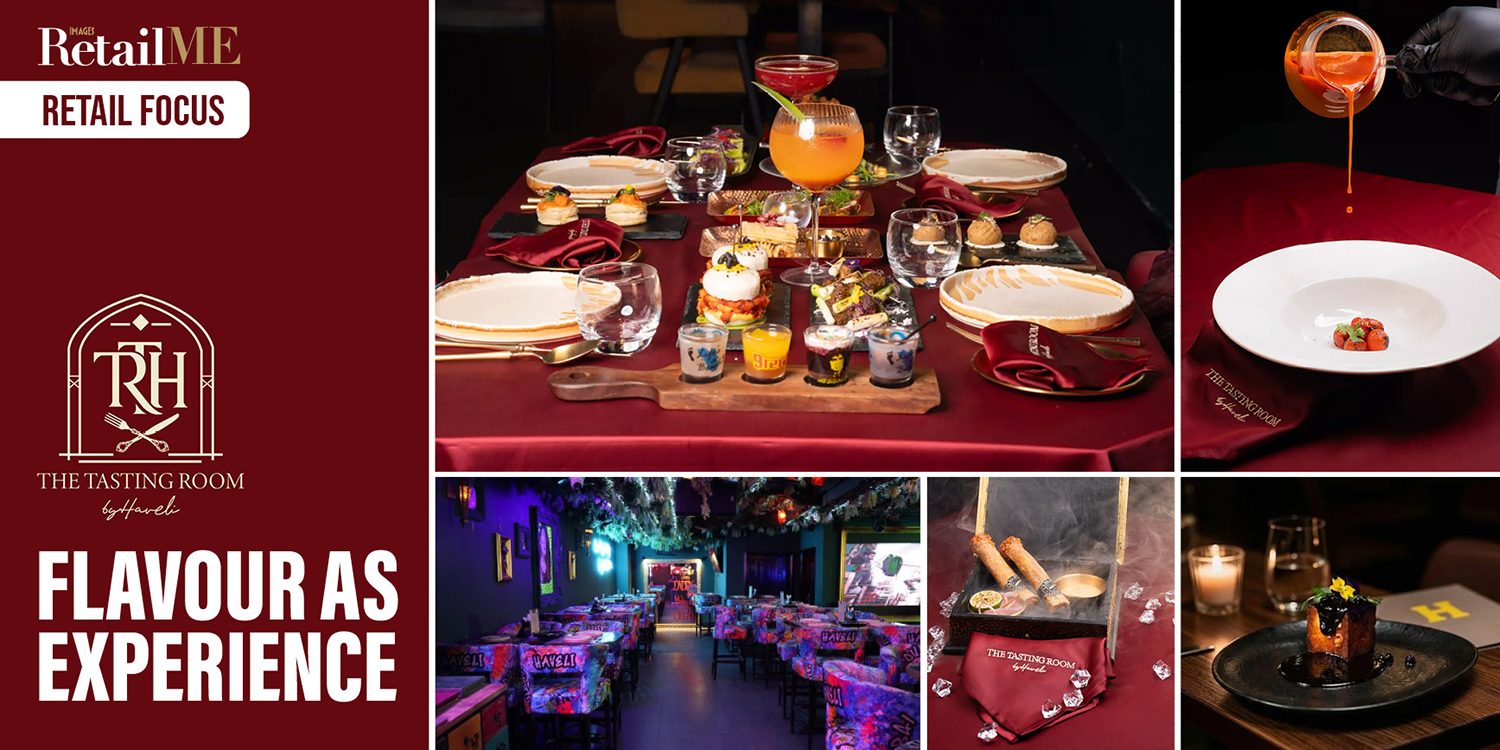
Tableside theatre, burrata cracked over butter chicken, a Laal Maas Cigar — Haveli’s daytime debut bets that diners now remember the moment as much as the meal. Founder Yogi on the rise of performance dining in the GCC.
Haveli made its name after dark. For years, the Dubai brand — a fixture for the city’s Indian and Asian expat community — has been synonymous with music, celebration and the high energy of a night out. Now it is doing something the market hasn’t seen from it before: switching on the lights. The Tasting Room by Haveli is a lunch-only fine dining concept, open Tuesday to Sunday from 12 pm to 8 pm and capped at just 100 guests a day.
Built around a philosophy its founder calls “Heritage Reimagined,” the concept reads the flavours of India through the grammar of modern fine dining. Black winter truffle, Siberian Baerii caviar, A2 cow ghee and wild honey run through a tasting menu engineered for theatre — a Laal Maas Cigar, burrata cracked open over butter chicken at the table, a Royal Truffle Khichdi, and a closing Nutella Jalebi Cheesecake. Guests choose from several formats, from an Executive Precision business lunch to the eleven-course Grand Odyssey, with formats starting from AED 150 per person.
It is a deliberate bet on a region where dining is increasingly judged not by the plate alone but by the memory it leaves behind. IMAGES RetailME sat down with Yogi, Founder and Chairman of The Tasting Room by Haveli, to talk about performance dining, the maturing of Indian fine dining in the GCC, and why he would rather do something exceptional for 100 guests than something average for 500. Here are the excerpts from the chat.
Haveli was never just about nightlife for me. The music, the energy, the celebrations – those were always a way of bringing people together. At its core, Haveli has always been about creating experiences. The Tasting Room is simply another expression of that philosophy. The setting is different, the pace is different, but the intention remains the same. We want people to feel something when they walk in and remember something when they leave. In many ways, nightlife taught us how to create moments. The Tasting Room taught us how to slow them down.
For me, heritage isn’t about recreating old recipes exactly as they were. It’s about respecting where they come from while making them relevant for today’s diner. Most of us grew up with certain flavours that carry memories of family gatherings, celebrations, and comfort. What excites me is taking those emotions and presenting them in a way that’s unexpected. I think people are craving that balance today. They want something new, but they also want something familiar. They want to be surprised, but they still want to feel connected to what they’re eating. That’s what Heritage Reimagined means to us.
I think people are consuming both the food and the experience. Food will always be the foundation. If the food doesn’t deliver, nothing else matters. But today, people want more than just a meal. They’re looking for experiences they can remember, talk about, and share. The tableside moments, the storytelling, the reveals — those aren’t there for spectacle alone. They’re there to make the diner part of the journey. When done right, performance dining isn’t about creating content. It’s about creating memories.
For a long time, Indian dining sat at two extremes – either casual comfort food or grand luxury experiences. I think the future lies somewhere in between. We’re seeing chefs and restaurateurs become more confident in telling regional stories, experimenting with techniques, and presenting Indian cuisine in a more contemporary way without losing authenticity. Globally and across the GCC, I think Indian dining is moving towards being more creative, more personal, and more experience-led. It’s becoming less about tradition versus innovation and more about how the two can coexist.
It was all three — operational, culinary and psychological. Operationally, limiting the number of guests allows us to maintain consistency and attention to detail. Every guest receives the experience exactly as we intended. From a culinary perspective, it gives the kitchen the ability to focus on execution rather than volume. And yes, psychologically, exclusivity matters. People value experiences that feel intentional and curated. But the real reason is simple: we would rather create something exceptional for 100 guests than something average for 500.
The key is respect. Innovation should never exist just for the sake of being different. Every dish we create starts with understanding why people love the original. Take butter chicken or khichdi. People don’t connect with those dishes because of the recipe alone. They connect with the memories attached to them. Our job is not to replace those memories. It’s to introduce a new layer to them. If a guest smiles and says, “This reminds me of something I know, but I’ve never experienced it this way before,” we’ve done our job.
Absolutely — hospitality today is multi-sensory. People have more choices than ever before. A restaurant today isn’t just competing with another restaurant. It’s competing with every experience available to consumers. That’s why hospitality is borrowing from fashion, art, music, theatre, and even wellness. People remember how a space sounded, how it felt, the conversations it sparked, and the emotions it created. Food may bring people in, but the overall experience is what keeps them coming back.
Definitely — I’ve always seen Haveli as more than a venue. What excites me is building experiences across different formats, different moods, and different occasions. Someone might celebrate with us at Haveli one evening and have a completely different experience at The Tasting Room the next afternoon. Five years from now, I see Haveli evolving into a hospitality ecosystem built around culture, experiences, food, entertainment, and community.
In today’s world, great food is expected. What people truly remember is how an experience made them feel. The dishes matter. The service matters. The design matters. But years later, what stays with you is the story you tell about that evening and the emotions attached to it. That’s what makes an experience memorable.



Watsons to open 20 new stores in the GCC
In 2020, global health & beauty retailer AS Watson Group signed its
April 29, 2024 | By Rupkatha BBeyond the Bouquet: Why Trust Is Becoming the New Currency of Gifting
From a Single Coffee Machine to a Regional Coffee Empire: The Coffee Planet Story
“If not me, then who?” — Inside Luved, the UAE’s New Pre-Loved Marketplace
/ 
For decades, Haldiram’s built deep recall across the UAE through its packaged

When House of Habanero opened its first physical location at Alserkal Avenue

Union Coop has completed a significant expansion of its Hatta Souq branch,

Saudi Arabia is set to welcome U.S. food exporters this week, as

Majid Al Futtaim has officially entered the discount retail segment with the

As convenience increasingly becomes currency in the region’s grocery landscape, Union Coop

As wellness becomes a lifestyle in the UAE, the grocery aisle is

Grandiose, one of the leading grocery retailers in the UAE with a

With shifting consumer behaviour, rising cost pressures, regulatory changes, and rapid digitization,

Union Coop’s blend of retail expansion, digital innovation, and community focus is

Abu Dhabi-based MAIR Group has marked a pivotal stage in its transformation

In a move that blurs the line between shopping and investing, Apparel
/ For decades, Haldiram’s built deep recall across the UAE through its packaged

In hospitality, brands are often discussed as concepts. But the strongest ones
At Souk Madinat Jumeirah, with the Burj Al Arab rising quietly in

Keto Kartel has entered the UAE’s premium wellness food space at a

With at least seven stores now operating across the country—mainly in Dubai,

The UAE Restaurant Group (UAERG), the official representative body of the country’s

As one of the world’s largest pizza chains, Little Caesars is making

Experiential dining has transformed the restaurant industry inculcating multi-sensory gastronomy to Instagram-worthy

From predictive inventory to robot deliveries, technology is reshaping the hospitality industry

The food service industry in the Middle East is being ushered into





 Previous Article