
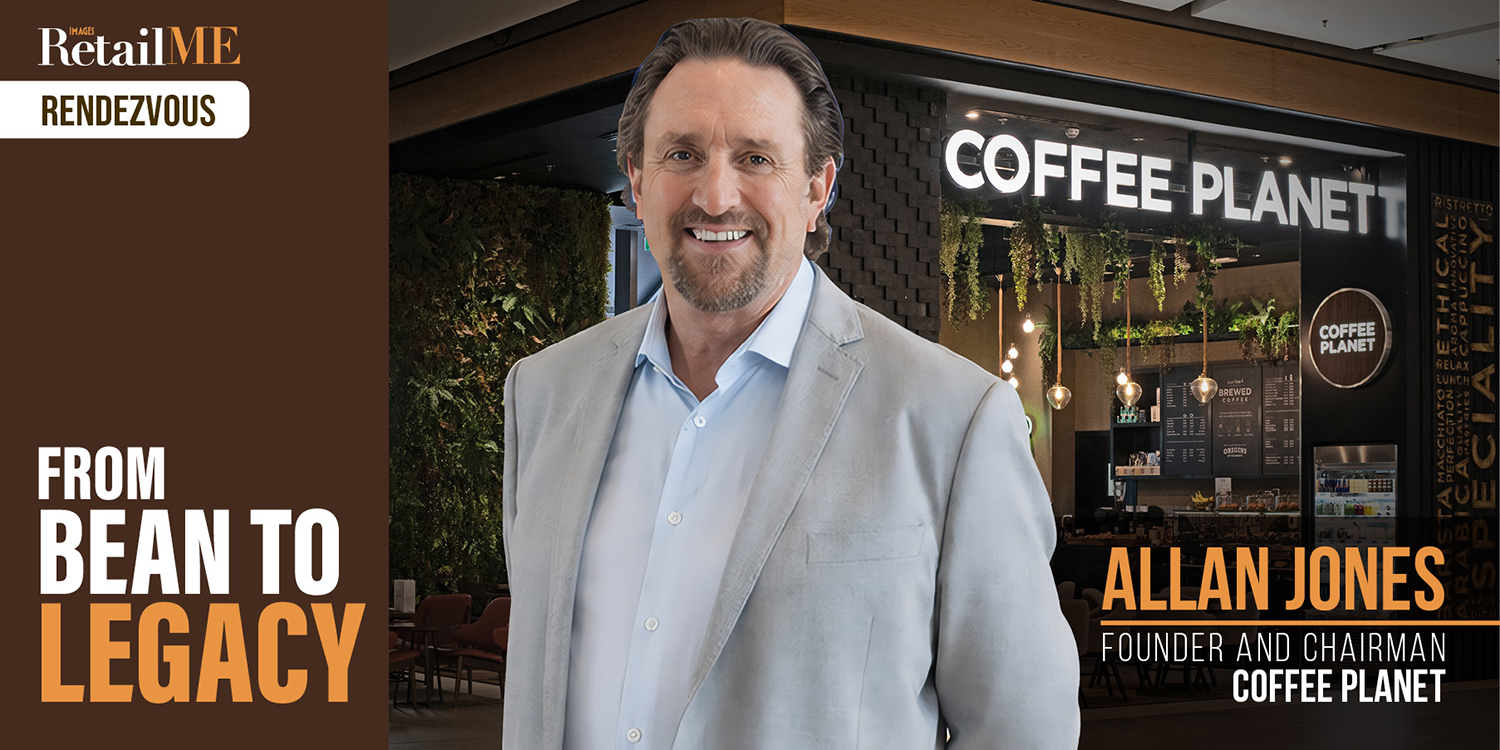
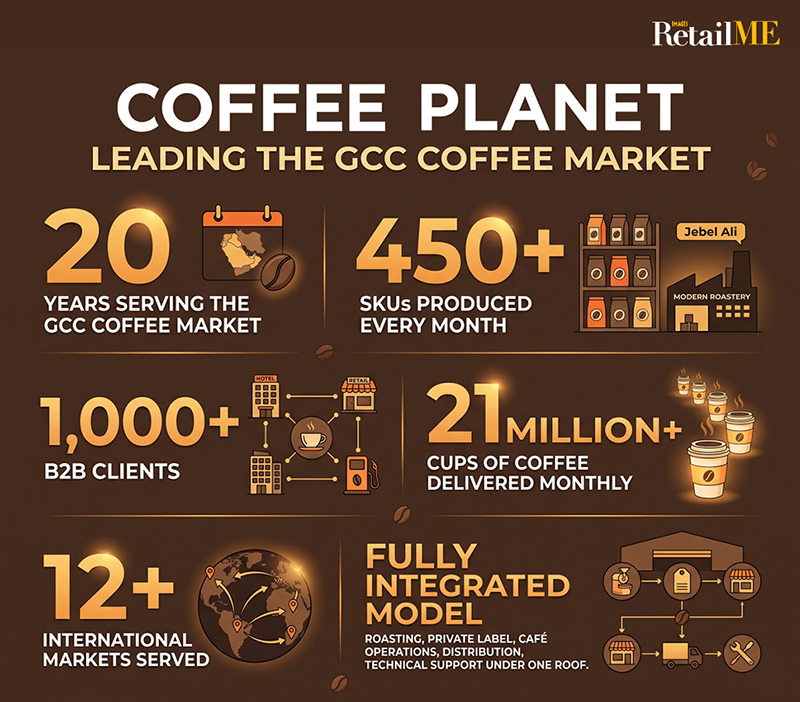
When Allan Jones first invested in Coffee Planet, it was a promising startup with a single coffee machine and a concept he believed in. Few could have predicted it would grow into one of the Gulf’s most influential coffee businesses. What began in 2005 has since evolved into a vertically integrated coffee business spanning retail, foodservice, private-label manufacturing, e-commerce, franchising, and large-scale roasting operations across the GCC.
Today, as Coffee Planet marks more than two decades in business, Jones remains as hands-on as ever, driven by the same entrepreneurial instinct that first drew him into the venture. For founder Allan Jones, however, the journey was never about chasing scale for its own sake. It was about building a business that could stand the test of time.
“Unless I took control of the business, I was going to lose my money and my partner’s money,” Jones recalls of the company’s earliest days. “So, I made a decision. If I was going to lose it, I’d rather lose it owning the business than watching it disappear.”
That decision would ultimately lay the foundation for one of the GCC’s most established coffee brands.
A Coffee Concept Ahead of Its Time
Jones was introduced to this startup concept(Coffee Planet) inspired by the service station coffee culture that was beginning to gain traction in the UK. Curious, he travelled to Britain to see the model for himself.
“I’d seen what was happening at motorway service stations in the UK,” he says. “People were buying quality coffee on the go. At the time, that wasn’t really happening here, and I thought there was an opportunity.”
What he found was a business in its early stages, operating from a modest office space with a single American coffee machine at its heart. While the concept showed promise, the next phase of growth required additional investment. Jones recognised the opportunity, increased his commitment to the business and eventually acquired a controlling stake, laying the foundations for what Coffee Planet would become over the next two decades.
The Birth of “Gourmet Coffee on the Hoof”
Coffee Planet’s first breakthrough came through an unconventional route: petrol stations. Working through franchise partnerships, the company began placing branded coffee machines inside service stations across the UAE, introducing motorists to freshly brewed coffee at a time when premium coffee culture was still emerging.
Jones gave the concept a memorable identity. “We started calling it ‘gourmet coffee on the hoof’,” he says with a smile. “People could grab a quality coffee while travelling, and that idea really resonated.” What began as a convenience offering soon gained unexpected visibility.
Government officials, business leaders and members of royal households regularly stopped at the locations. “Suddenly important people were trying the coffee,” Jones says. “Then we started receiving requests for coffee machines in palaces and private locations. That’s when we realised the brand was gaining recognition.” The momentum quickly spread beyond service stations and into mainstream retail.
From Forecourts to Supermarket Shelves
As demand grew, Coffee Planet expanded into supermarkets and hypermarkets, building relationships with retailers including Waitrose, Spinneys and other major grocery operators. The company also acquired food production capabilities, allowing it to broaden its offering and strengthen its retail presence. What emerged was a diversified business model that extended far beyond cafés.
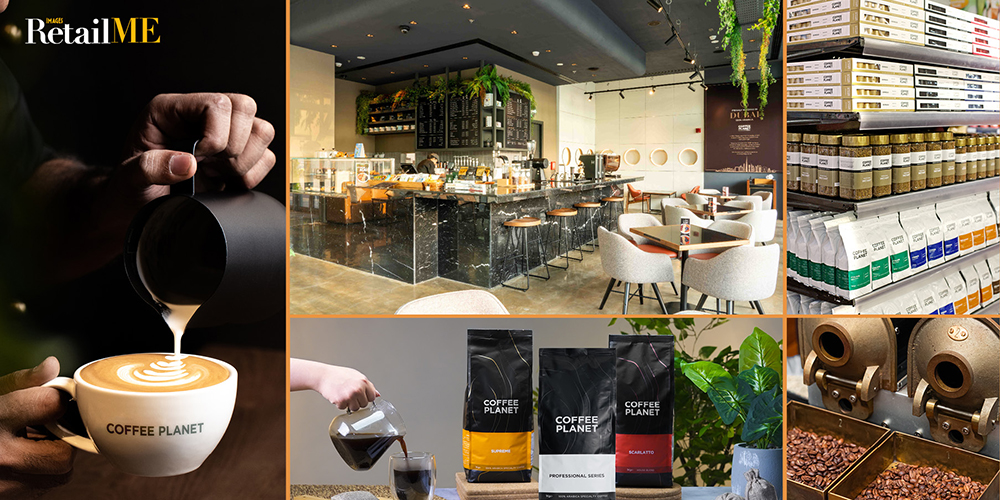
Today, Coffee Planet operates across retail, hospitality, private label manufacturing, e-commerce, foodservice and corporate supply channels. Yet despite the diversification, coffee quality remains at the centre of every decision.
Why Competition Never Became a Concern
The Gulf coffee market has transformed dramatically over the past two decades. International chains have expanded aggressively. Independent cafés have flourished. Specialty coffee has become mainstream.
But Jones insists competition has never kept him awake at night. “Competition has never bothered us because quality is in the cup,” he says. “We’ve always believed that if the coffee is better, customers will come back.”
That conviction led to one of the company’s most important strategic decisions: bringing roasting operations to the UAE. Previously, Coffee Planet’s coffee was roasted in London before being shipped to the region. While the arrangement worked, Jones recognised that local roasting would create a significant competitive advantage.
“We realised we needed to roast on the ground here,” he explains. “Today our roastery is about twenty minutes away. That’s a completely different proposition from shipping roasted coffee halfway across the world.” The move not only improved freshness but also strengthened the company’s identity as a homegrown regional brand.
“When you’re roasting locally, you’re delivering coffee at its best,” he says. “That freshness matters.”
Growth Without Giving Away Control
In an era when many businesses pursue rapid growth through private equity, acquisitions or public listings, Jones has chosen a different path. Over the years, Coffee Planet has attracted interest from investors and industry players looking to buy into the business.
He has consistently declined. “I’ve never had any ambition to be managed by somebody else,” he says. “Keeping the company in private hands means we can make decisions quickly and stay true to what we’ve built.”
The approach reflects a broader philosophy that has guided Coffee Planet’s growth. Rather than chasing valuation headlines, Jones has focused on creating long-term shareholder value through steady reinvestment. “Every pound we’ve made has gone back into strengthening the business,” he says. “The balance sheet matters. The long-term value matters. That’s what creates a business people want to buy one day.”
The Margin Conversation Nobody Likes to Have
In the foodservice sector, few topics generate as much debate as margins. For Jones, however, the issue is straightforward.“Margins matter because they’re what allow you to reinvest,” he says. “Without margins, you can’t improve quality, you can’t grow, and you can’t build a sustainable business.”
That philosophy has occasionally meant walking away from opportunities. “We’re not in business to subsidise somebody else’s growth,” he says candidly. “If an opportunity doesn’t make sense commercially, we’ve never been afraid to say no.” The discipline has helped Coffee Planet navigate everything from economic downturns to the disruptions of the pandemic, while maintaining profitability and investing in future growth.
Technology’s Growing Role
As artificial intelligence reshapes industries around the world, Coffee Planet is actively integrating technology into its operations. The company has already implemented enterprise-wide systems that connect sourcing, manufacturing, logistics and distribution, creating greater visibility across the business. In fact, the company prides in their state-of-the-art ERP system that connects the backend with the frontend across operations seamlessly. Jones believes the next wave of transformation will come from AI.“You have to move with the times,” he says. “Businesses that ignore technology risk being left behind.”
While AI remains a developing area for the company, he sees significant potential in everything from operational efficiency and governance to forecasting and decision-making. “The question isn’t whether you’ll use AI,” he says. “The question is how quickly you’ll learn to use it effectively.”
Eyes on Saudi Arabia
The next major chapter for Coffee Planet is already taking shape. While the UAE remains its home market, Saudi Arabia has become the company’s most important growth priority.
The business already operates through distribution and franchise partnerships across the Kingdom, but Jones believes the opportunity is only beginning. “Saudi is where a lot of the future growth is going to come from,” he says. “The developments happening there are creating opportunities across retail, hospitality and foodservice.” Central to that strategy is local production. “Our goal is to open a roasting facility in Saudi Arabia,” he reveals. “If we’re serious about serving the market properly, we need to roast there just as we do in the UAE.”
The move would represent one of the company’s biggest investments since establishing its UAE roasting operations and further cement its regional ambitions.
The Lessons of Twenty Years
Ask Jones what two decades in business have taught him and his answer comes quickly.
Ambition.
“If you don’t have ambition and drive, go and work for somebody else,” he says. “Building a business isn’t a nine-to-five job. It’s a seven-day-a-week commitment.”
Patience.
Too many entrepreneurs become distracted by short-term rewards, he argues, rather than focusing on sustainable growth.
Accountability.
“If something goes wrong, it’s my fault,” he says. “I’ve never had the luxury of pointing at somebody else. That’s part of being an owner.”
It is a philosophy that has shaped Coffee Planet from day one. Twenty years after backing a little-known startup with a single coffee machine, Jones remains focused on the same fundamentals that got him here: quality, discipline and long-term thinking.
The coffee industry may have changed dramatically since 2005, but his approach has not.
“Every business has a value,” he says. “My responsibility is to make sure this one is stronger tomorrow than it is today.”
For Coffee Planet, that long game is still very much in motion.


Watsons to open 20 new stores in the GCC
In 2020, global health & beauty retailer AS Watson Group signed its
April 29, 2024 | By Rupkatha B / 
For decades, Haldiram’s built deep recall across the UAE through its packaged
When House of Habanero opened its first physical location at Alserkal Avenue
Union Coop has completed a significant expansion of its Hatta Souq branch,

Saudi Arabia is set to welcome U.S. food exporters this week, as
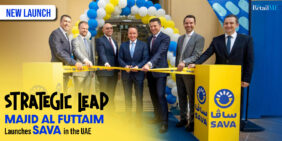
Majid Al Futtaim has officially entered the discount retail segment with the
As convenience increasingly becomes currency in the region’s grocery landscape, Union Coop

As wellness becomes a lifestyle in the UAE, the grocery aisle is

Grandiose, one of the leading grocery retailers in the UAE with a

With shifting consumer behaviour, rising cost pressures, regulatory changes, and rapid digitization,
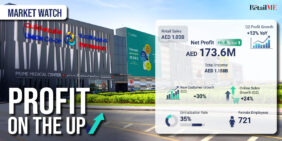
Union Coop’s blend of retail expansion, digital innovation, and community focus is
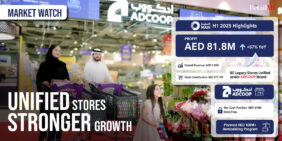
Abu Dhabi-based MAIR Group has marked a pivotal stage in its transformation

In a move that blurs the line between shopping and investing, Apparel
/ 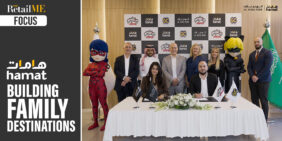
Hamat announces the signing of a 10-year agreement with Ground Control Entertainment
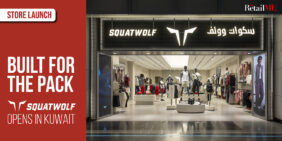
SQUATWOLF has opened its first standalone store in Kuwait at The Avenues,
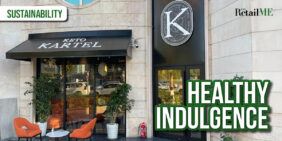
Keto Kartel has entered the UAE’s premium wellness food space at a
With the signing of a landmark partnership between Wafi Group and ALMAD
Under the patronage of His Royal Highness Prince Saud bin Mishaal bin

Inside Dubai’s newest culinary theatre where memory, art, and modern craft come

Majid Al Futtaim is strengthening its lifestyle portfolio with a move into

Liali Fine Jewellers is a Dubai-based jewellery brand established in 1999. Over

The entrepreneurial journey from a single outlet to a multi-location empire is

From frictionless checkouts to AI-powered inventory, retail’s digital backbone took center stage
In a move that blurs the line between shopping and investing, Apparel





 Previous Article