

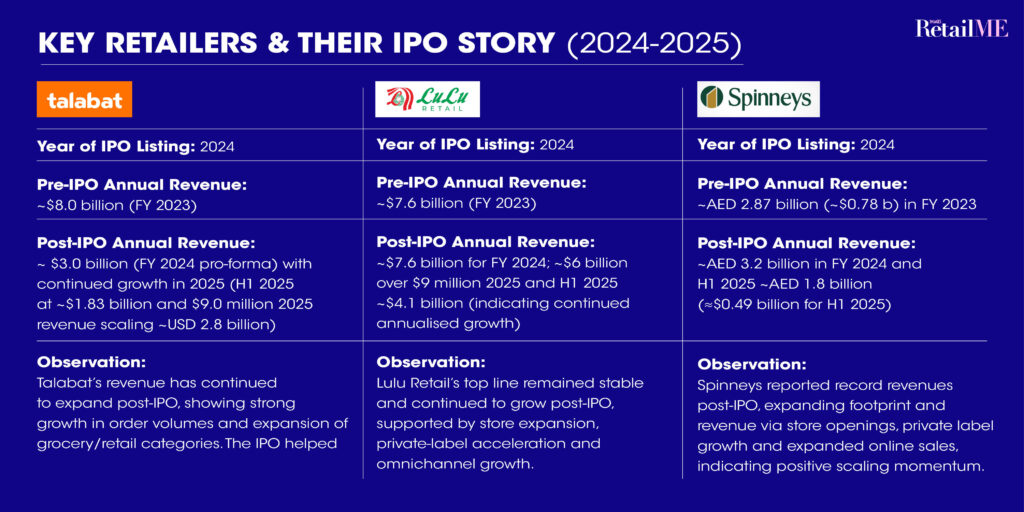
After a breakout year for retail IPOs across the MENA region in 2024, the market has moved into a more restrained phase through 2025 and into 2026. What initially appeared to be a sustained reopening of public markets has given way to a period of recalibration, as issuers and investors alike weigh macro volatility, valuation discipline and post-listing performance. The shift has reframed the IPO conversation for consumer-facing businesses, raising a central question: was the surge a peak, a pause, or a more selective path forward?
According to Shweta Sukhija, Director, Accounting and Finance, UAE, at KPMG Middle East, the slowdown reflects tighter discipline rather than diminished confidence in the sector’s fundamentals. While softer oil prices and global liquidity constraints have tempered risk appetite, long-term growth drivers — including population expansion, urbanisation and sustained consumption — remain firmly in place. What has changed is the bar for readiness, pricing and governance, as public market investors demand clearer differentiation and stronger institutional frameworks.
In a conversation, Sukhija shares that for retail and consumer companies contemplating a listing, the IPO decision today extends well beyond capital raising. It has become a test of operational maturity, financial rigour and leadership mindset, particularly for founder-led and family-owned businesses transitioning into public ownership. As recent listings underscore divergent expectations for asset-heavy retailers versus platform-led models, the path to the public markets increasingly hinges on disciplined execution, credible reporting and a compelling equity story built for life after listing — not just the debut.
2024 was a watershed year for retail IPOs in MENA, while 2025 has been quieter. Is this a peak, a pause, or a structural shift?
2024 offered a rare alignment: supportive market conditions, government backing, PE exits and strong investor appetite. In 2025, softer oil prices, tighter global liquidity and regional uncertainty have cooled risk appetite, making issuers and investors more selective.
Post-IPO performance has also been mixed. While growth has been reasonable, premium IPO valuations have limited upside, prompting boards to reassess timing, pricing and readiness. The slowdown looks cyclical rather than structural. Long-term fundamentals — population growth, urbanisation and consumption remain intact, but valuation discipline and listing standards have clearly tightened.
In IPO readiness, where do retail and consumer companies most often fall short?
The story is rarely the issue. Most companies have strong brands and growth narratives. The gaps tend to be institutional.
Finance and governance are the biggest pressure points. Family-owned structures can work well privately, but public markets demand independent boards, clear decision rights and audit-ready IFRS reporting. That often requires a fundamental shift in how leadership teams operate. Our 2025 KPMG Global Family Business Report shows this transition is underway, but not yet universal.
What is the real strategic trigger for a retail company to choose an IPO over staying private?
In our experience, while private capital remains accessible, it may often require giving up a significant equity stake. Retail founders may pursue an IPO when they want to raise capital while retaining control, or when investors seek a partial exit. An IPO provides a structured way to monetise holdings, access broader capital without losing majority control, and establish a transparent market valuation. Beyond liquidity, it also enhances brand visibility, institutional credibility, and positions the company for future growth financing.
Grocery and quick-commerce players dominated recent listings. What do public market investors now expect differently from asset-heavy retail versus platform-led models?
Recent listings have been dominated by grocery and quick-commerce players, highlighting two distinct investor mindsets. For asset-heavy retail, investors value predictable cash flows, stable margins, and capital efficiency, while tech- or platform-led models appeal to those seeking high-risk, high-return opportunities and scalable growth. Across both, operational excellence is the non-negotiable factor, driving investor confidence. The key challenge for retail players is remaining relevant in a hybrid consumer landscape, where shoppers expect both immersive in-store experiences and seamless digital access.
What is the biggest mindset change founders and family-owned retailers must make when transitioning from private ownership to life as a listed company?
The biggest mindset shift for founders and family-owned retailers transitioning to public ownership is embracing independent oversight and accountability. Many are accustomed to fast-paced, centralised decision-making, but life as a listed company requires structured, transparent processes subject to external scrutiny. In our experience, IPOs are far more likely to stumble when leadership struggles to fully internalise and adopt this shift in governance and culture.
KPMG often references the ‘post-IPO reality gap.’ Where does this show up most in retail?
Financial reporting discipline. Many newly listed retailers underestimate the pace and scrutiny of public markets. Quarterly reporting, continuous disclosure and audit expectations can overwhelm teams used to private reporting cycles. High-volume, low-margin models add complexity, especially around real-time sales data, inventory valuation and cost controls. Closing the gap requires stronger finance teams, robust systems and embedded controls aligned to public-market standards.
If advising a retail CEO today, what are the three non-negotiables before filing for an IPO in MENA?
First, a differentiated equity story. Given recent IPO underperformance, companies must clearly articulate how they stand apart and how they will deliver sustainable public-market returns.
Second, a strong finance function. Investors may buy into the CEO’s vision, but they trust the numbers. Credible forecasting, reporting and transparency are essential.
Third, a clearly defined perimeter. Being explicit about which geographies and businesses sit within the listed entity is critical to valuation clarity and execution certainty.


Watsons to open 20 new stores in the GCC
In 2020, global health & beauty retailer AS Watson Group signed its
April 29, 2024 | By Rupkatha B“If not me, then who?” — Inside Luved, the UAE’s New Pre-Loved Marketplace
Sedar Global: 134 Years of Crafting Spaces, Now Reimagining the Future
/ 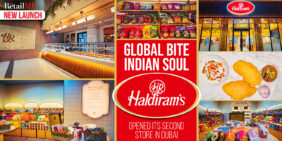
For decades, Haldiram’s built deep recall across the UAE through its packaged

When House of Habanero opened its first physical location at Alserkal Avenue
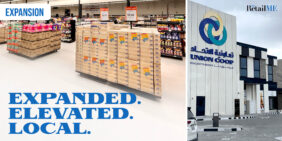
Union Coop has completed a significant expansion of its Hatta Souq branch,

Saudi Arabia is set to welcome U.S. food exporters this week, as

Majid Al Futtaim has officially entered the discount retail segment with the

As convenience increasingly becomes currency in the region’s grocery landscape, Union Coop

As wellness becomes a lifestyle in the UAE, the grocery aisle is

Grandiose, one of the leading grocery retailers in the UAE with a

With shifting consumer behaviour, rising cost pressures, regulatory changes, and rapid digitization,
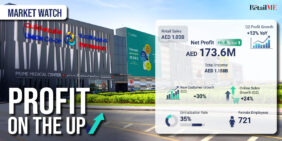
Union Coop’s blend of retail expansion, digital innovation, and community focus is
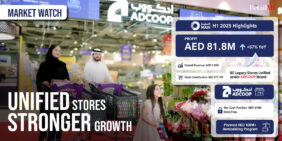
Abu Dhabi-based MAIR Group has marked a pivotal stage in its transformation

In a move that blurs the line between shopping and investing, Apparel
/ 
Saudi Arabia’s retail sector is rapidly transforming under Vision 2030. E-commerce, brick-and-mortar

At the heart of retail lies the consumer, Deloitte pointed out while

The GCC retail industry is projected to grow at a compound annual

The retail landscape in the Middle East is undergoing a seismic shift,
Akshay Jayaprakasan, Associate partner, REDSEER in his research presentation at the Internet
In an exclusive interview Krishna Dhanak, Managing Director, Alpen Capital shared insights
A Tabby survey indicates that 82% of shoppers find online shopping frustrating.

Adgild Hop, Market Lead, Partner Retail for Deloitte took to stage at
Google offers a look at some major trends dominating the retail landscape





 Previous Article