

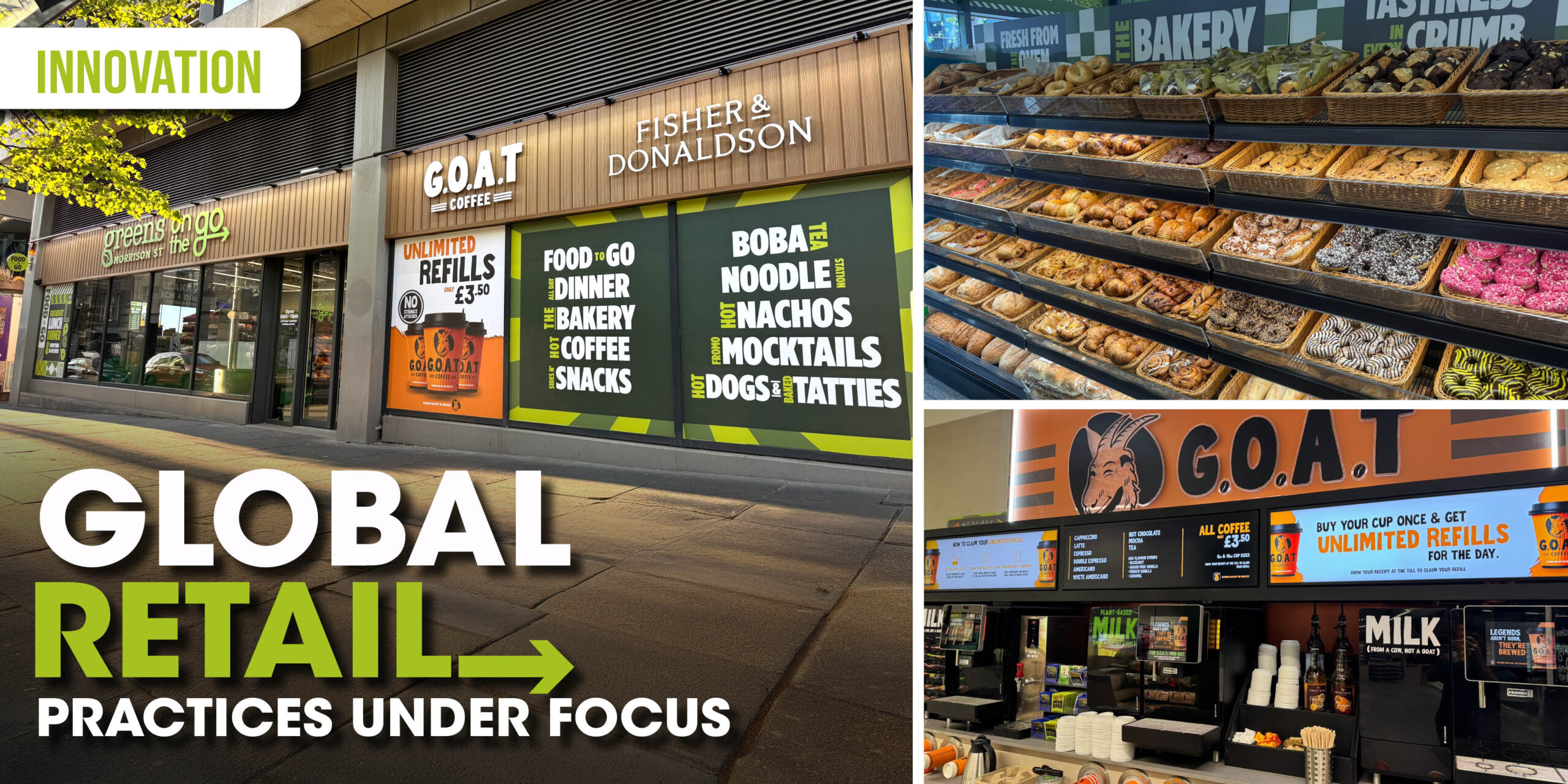
As lives accelerate and time fragments, shoppers no longer separate “eating” from “errands.” They expect proper food, instantly, wherever they are and whenever they need it. Across the UK and globally, the sharpest operators are responding by collapsing the lines between convenience retail and foodservice, designing compact, high-throughput formats built for speed, freshness and real consumption moments. The winners are not chasing buzzwords. They are building around behaviour.
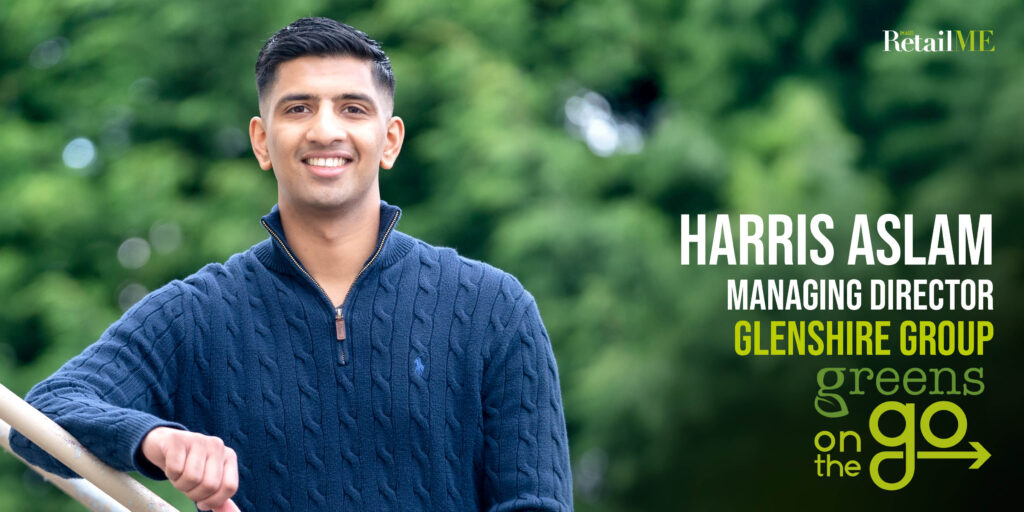
At the forefront of this shift is Glenshire Group, a fast-growing family conglomerate spanning convenience, QSR, hotels and construction. Led by Managing Director Harris Aslam, the group’s newest concept, Greens on the Go, fuses convenience and food into what Aslam calls true “foodvenience”. Launched in Edinburgh to strong early traction and now scaling across Scotland, the model is attracting interest from beyond the region by doing one thing exceptionally well: delivering quality food at the pace of modern life.
In conversation with him, we try to uncover how Greens on the Go is ready to redefine the concept of grocery globally by creating a benchmark of convenience.
Why this format, now?
We started with one reality: time poverty. Customers want crave-worthy food, immediately. Not just sandwiches, but proper meals, fresh bakery, barista coffee and chef-prepared options. If it isn’t ready to eat or drink right now, it needs a very good reason to exist. That’s foodvenience for us: useful, relevant, 24/7, and built on how people actually move through their day. No fluff.
What about performance and profitability?
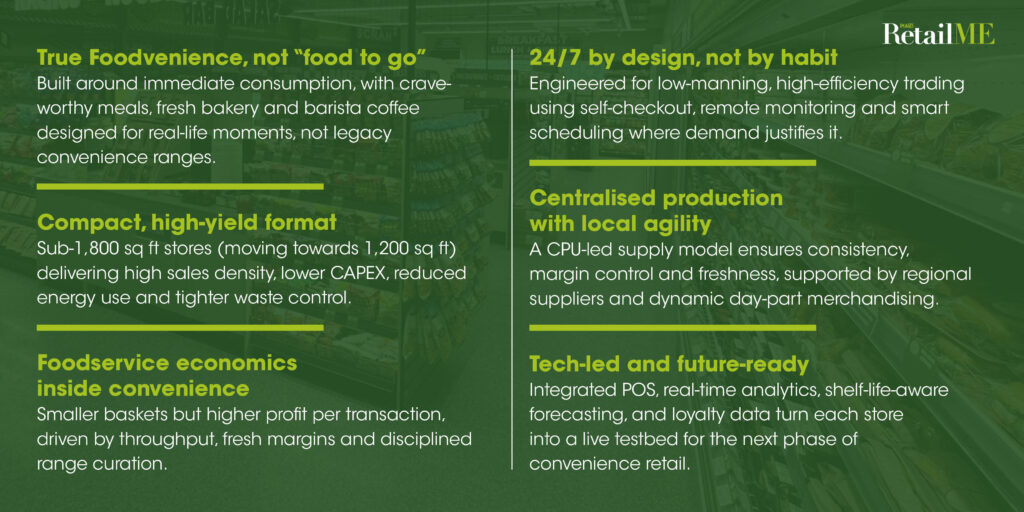
We don’t benchmark against traditional c-stores. We benchmark against food-to-go specialists. The format is intentionally low-CAPEX and compact: sub-1,800 sq ft today, heading towards 1,200 sq ft. Fewer fridges, tighter ranges, higher sales density. The result is lower build and energy costs, less waste, and foodservice-level margins driven by throughput rather than basket size.
What global inspirations did you take when building Greens on the Go?
Hybrid models in the Middle East, Southeast Asia and the US were influential. The biggest lesson from MENA was design and aspiration even in high-frequency formats. We visited operators pushing boundaries in Riyadh and beyond. What’s clear is that customer maturity shapes the proposition. You design for habits, not headlines.
How are you making 24/7 work?
With UK labour costs rising to a true £17.50 per hour, traditional manning doesn’t scale. We rebuilt the model around smart scheduling, multi-skilled teams, self-checkout, remote monitoring and IoT alerts. The outcome is low-manning, high-efficiency trading overnight, without compromising service or safety. Where the location fits, 24/7 builds a loyal, habitual customer base.
How do you maintain supply chain agility and keep waste at check?
The move to a Central Production Unit is pivotal. It gives us control, consistency and margin. Combined with a hub-and-spoke model, daily forecasting, digital markdowns and day-parted merchandising, we’re keeping waste tight while keeping the range fresh and dynamic. Initiatives like Too Good To Go help close the loop.
How about the tech backbone?
UK convenience has underinvested in tech. We’re building an integrated stack covering POS, inventory forecasting with shelf-life awareness, digital shelf labels, production software, loyalty and real-time analytics. Innovation also shows up in format firsts: unlimited 24-hour coffee refills, and a full hot, cold and beverage ecosystem packed into under 1,800 sq ft.
Let’s talk about the role of omnichannel
Greens on the Go is a testbed. Click-and-collect meal kits, dynamic pricing, in-store media, AI planograms and loyalty mechanics are all being trialled here. It also lays the groundwork for delivery-only kitchens using the same tech and menus.
What’s next?
The next phase of convenience is hyper-local, service-led and data-driven: subscriptions, autonomous formats and personalised recommendations. With proof of concept in place, our focus is a rapid Scotland rollout in 2026, followed by selective UK expansion. Scale first. Speed second. Relevance always.



Watsons to open 20 new stores in the GCC
In 2020, global health & beauty retailer AS Watson Group signed its
April 29, 2024 | By Rupkatha B“If not me, then who?” — Inside Luved, the UAE’s New Pre-Loved Marketplace
Sedar Global: 134 Years of Crafting Spaces, Now Reimagining the Future
/ 
For decades, Haldiram’s built deep recall across the UAE through its packaged

When House of Habanero opened its first physical location at Alserkal Avenue

Union Coop has completed a significant expansion of its Hatta Souq branch,

Saudi Arabia is set to welcome U.S. food exporters this week, as

Majid Al Futtaim has officially entered the discount retail segment with the

As convenience increasingly becomes currency in the region’s grocery landscape, Union Coop

As wellness becomes a lifestyle in the UAE, the grocery aisle is

Grandiose, one of the leading grocery retailers in the UAE with a

With shifting consumer behaviour, rising cost pressures, regulatory changes, and rapid digitization,

Union Coop’s blend of retail expansion, digital innovation, and community focus is

Abu Dhabi-based MAIR Group has marked a pivotal stage in its transformation

In a move that blurs the line between shopping and investing, Apparel
/ 
In the race to reinvent physical retail, many concepts promise the future

For years, Primark has challenged one of modern retail’s most entrenched assumptions:

The Inspired Home Show 2025 concluded with positive momentum, reinforcing its position

“Luxury is no longer just about the product—it’s about the experience,” says

64 global leaders in retail will share their insights on shaping the

NRF 2025: Discussing biometrics, computer vision and more with leaders from H&M,

CION Lighting Technologies approaches innovation in a proactive and collaborative manner.

Marchon Eyewear, Inc., one of the world’s largest manufacturers and distributors of

This panel discussion at MRF 2024 explored the balance between digital-first brands

The short answer is, yes. The global personal luxury market seems to





 Previous Article