


At the AI Roundtable, technology heads, marketers, and leaders explored how AI is reshaping the industry from the inside out. The session unpacked the real-world impact of generative, cognitive, and predictive AI tools already in motion across retail ecosystems.
Moderated by Vishal Kapil, Chief Technology Officer, MAIR Group, the panel made clear that AI has moved past the hype, now central to sharper customer experiences, leaner operations, and smarter talent models.
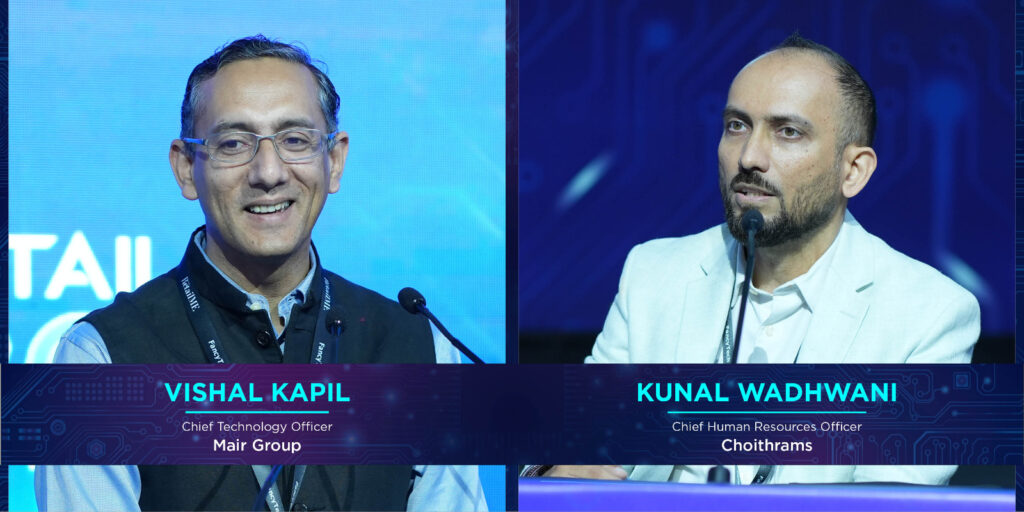
Vishal emphasised that AI is a priority for companies as well as the government. Giving the floor to Kunal Wadhwani, CHRO, Choithrams, Vishal asked, “How are organisations implementing modernisation, whether it is driven more by technology or by people? In the context of AI, it becomes important to understand how much focus is placed on the workforce in transformation efforts, and what people need to do to stay relevant and succeed in an AI-enabled future.”
Kunal emphasised that grasping the core identity of an organisation is essential for successful implementation, particularly in retail, where understanding the business proposition is crucial regardless of individual roles.
He said, “You must know what the company stands for. Our organization operates in both brick-and-mortar and e-commerce, while others in the same sector may follow different procurement strategies. This context influences how and why AI should be implemented.”
Kunal stressed that organisations must define a clear purpose for using AI, not just follow trends. Success requires setting the right cultural tone, preparing people for change, and aligning workforce strategies with new AI models. Ultimately, AI should enable employees to evolve into higher-value roles, not continue doing the same tasks.
Vishal turned to Kartik Bhatt, Chief Digital Officer, Modern Electronics – MEC (AL-Faisaliah Group) (Sony, Hitachi, PS5) for insights from both on-ground realities and boardroom decision-making.
Kartik stressed that transformation in retail often fails because organisations overlook readiness of their people, processes, and legacy systems.
He added, “If the processes are not aligned, you may end up investing a hefty amount in a monolithic system that no one knows how to leverage. Six months later, you’re stuck in a familiar loop: rising tech costs, misaligned operations, and the reflex to start firing people while bringing in more technology. It becomes a vicious cycle.”
He stressed, “There are two types of tech buyers in retail. One buys out of urgency or fear of missing out, wanting the latest tool just because competitors have it. The other evaluates technology based on clear business needs, performance gaps, and ROI, conducting due diligence before investing. Retailers must decide which mindset they operate from: reactive and cosmetic, or strategic and value-driven.”
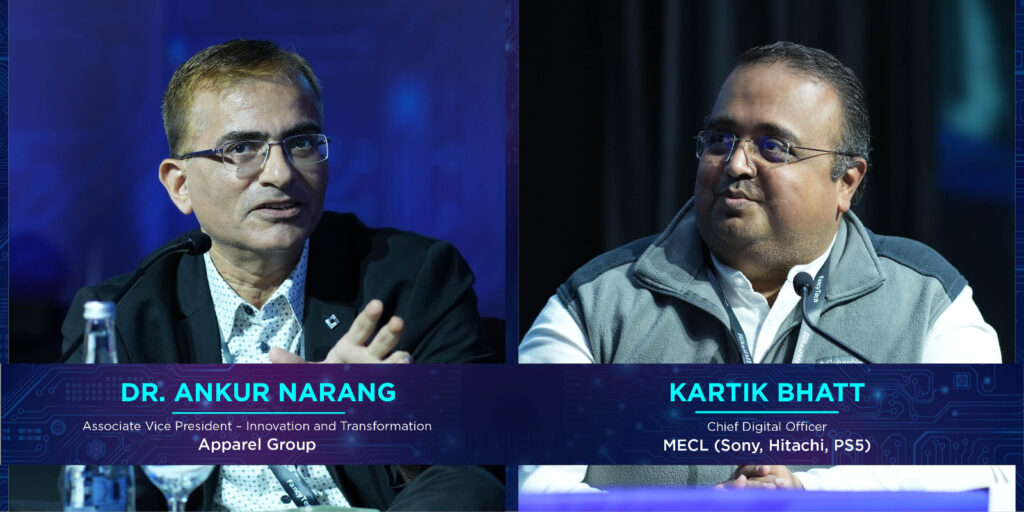
Dr Ankur Narang, Associate Vice President – Innovation and Transformation, Apparel Group said, “The first step is getting alignment from the board, which plays a crucial role in deciding whether and how much the company is ready to invest. Even when the board is aligned, there can still be concerns about ROI. Now, with proven case studies globally, especially from the West, we know that if implementation is right, we will achieve fundamental ROI, if not deeper impact.”
He emphasised that after securing board alignment, the focus should be on building a clear roadmap and identifying business areas with quick, demonstrable impact. This means starting with short-cycle projects to show ROI.
Vishal pivoted the conversation toward execution realities. Posing a question to Murali Krishnan, CHRO, Jumbo Group, he asked, “Do business heads actually have the bandwidth for another big initiative? In my experience, even high-ROI projects get delayed because people are stretched with store openings, operations, and legacy problem-solving. How do you drive transformation when no one has the time?”
Murali responded, “Most organisations are at a tipping point right now. There’s a general sense that AI is coming, but many still believe there’s time. Even before AI, just digital transformation itself is shaking things up. At Jumbo Electronics, we’re currently rolling out SAP S/4HANA, and the transformation has been seismic.”
Change management is complex, budgets are tight, and multiple pressures add layers of complexity. To manage this, Jumbo is adopting a dual-track approach, setting up a dedicated transformation team to drive change without disrupting daily operations.

Muskan Gupta, Head of Marketing UAE, FirstCry.com (BrainBees Solutions Ltd.) highlighted a marketing-focused perspective. Over the past year, FirstCry has transitioned from expensive, traditional photoshoots to fully AI-generated content, from brand videos to seasonal campaigns like Ramadan and Back-to-School.
“The transition was made successful by the involvement of a small core team of around 3 to 4 key decision-makers, who aligned on the business case from a cost-efficiency and P&L perspective. Importantly, the brand chose to upskill rather than replace talent. So AI is proving especially valuable in marketing, speeding up content creation, ad optimisation, and campaign delivery to help teams work faster and more efficiently,” Muskan added.
Ahmed Hussain, Co-Founder & Chief Innovation Officer, Pathfinder Phygital AI, provided perspective on legacy challenges, “Legacy systems exist for a reason. They’ve been at the core of enterprises for years, supporting critical functions like finance and supply chain. But instead of a full overhaul, I advocate for micro-modernisation: take a small part, build an MVP, prove its value, and then scale. This approach allows quick proof of concept and gradual transformation.”
Rupam Bhattacharjee, Co-Founder and CEO, WaysAheadGlobal added, “The complication is fundamentals in terms of the data, where the scattered data is not integrated properly. Additionally, whatever we try to build, be it AI, or robots, or bots, there are chances that it will not function properly. So two things are important for any organization: first, understanding where their data sits; and second, creating awareness about it.”
Rupam emphasised there’s also a mindset gap. While tech leaders chase the AI race outside, few are focused on fixing the internal race first. He flagged the rise of unstructured data, now making up nearly 90% of what businesses have, as a core challenge.
Returning to core principles, Kartik said, “Fundamentally, there are three key elements: consistency of performance, accuracy of operations, and pace of operations. To get this right, you must move from legacy, manual, people-dependent processes to people-powered processes.”
Complex demand planning can no longer rely on Excel or basic code, it needs predictive algorithms. Similarly, boosting sales through cross-sell/upsell engines or managing high-volume customer queries requires scalable AI solutions.
Kunal added a note of caution, “The whole infrastructure of AI today is built on the wisdom of legacy processes, transformation must be driven by internal need, not external influence. We need to show how the process will change, what our employees will do differently, and how the P&L will benefit.”
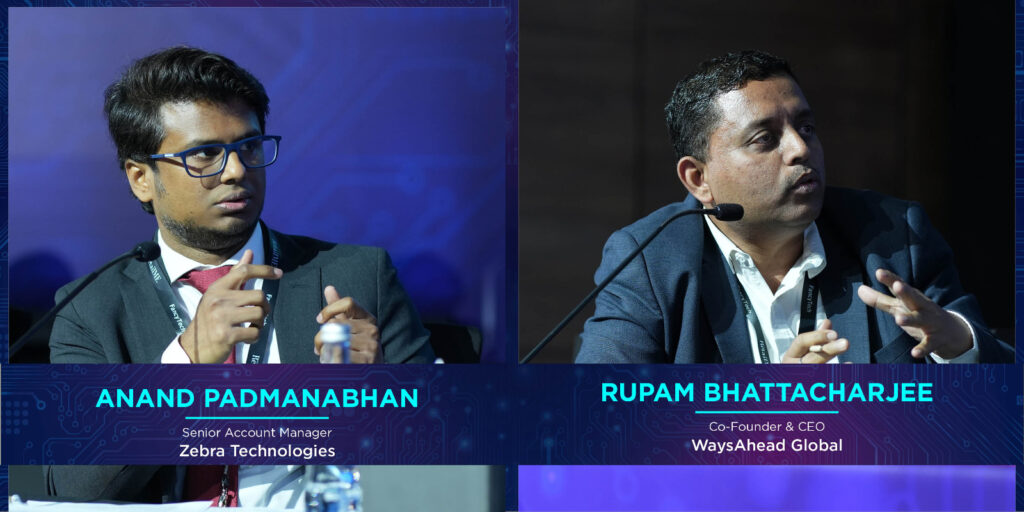
Vishal turned to Anand Padmanabhan, Senior Account Manager, Zebra Technologies, who has been guiding retailers through supply chain transformation. “People say they want all these advanced technologies, but when you meet technology leaders and their teams, what do you see that people don’t buy into or get excited about?”
Drawing from Zebra’s 50-year transformation journey, Anand outlined their focus on three pillars: elevating customer experience through low-cost, high-impact technologies; connecting frontline workers to enhance selling capabilities; and optimizing inventory with AI-driven prescriptive analytics.
“We were working with a retailer who kept requesting more Zebra assets for their outlets, but our agent tool showed their usage was only 30%. Instead of selling more equipment, we helped them minimise costs—even though it was counterproductive for our sales. That’s the collaborative journey we need to be on.”
Moving on, Vishal addressed platform proliferation with Adriano de Souza e Silva, Head of Growth – MEA and APAC, VTEX. Adriano shared insights from recent work with Manchester City, Majid Al Futtaim Group, and Tata Digital. His observation was striking: despite AI discussions, companies aren’t mastering the basics.
“When I look at conversion rates on e-commerce platforms, the average is 3-4%. Companies have 30 legacy systems to integrate, many still use Excel files for B2B channels, and less than 10% are doing true omni-channel in this region,” Adriano pointed out, revealing that UAE’s online penetration is just 3%.
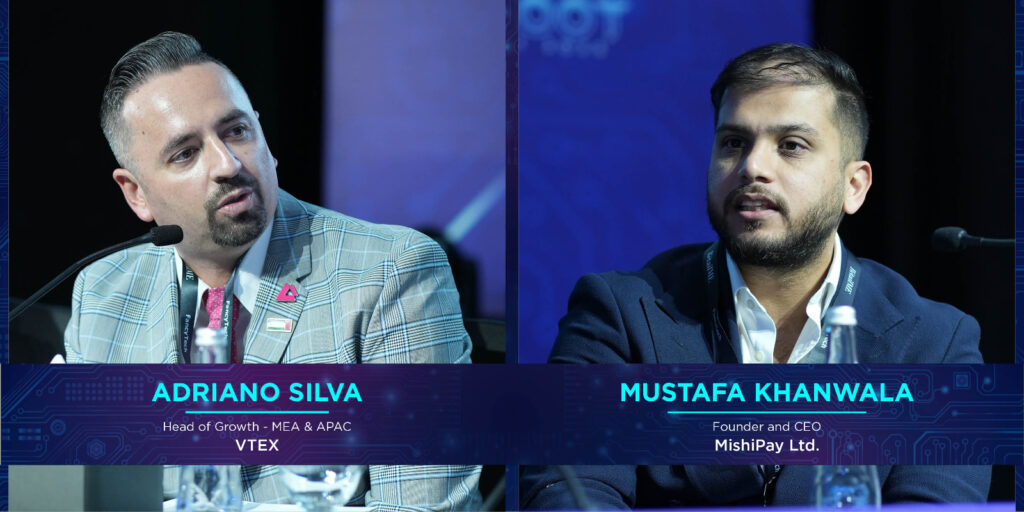
Mustafa Khanwala, Founder and CEO, MishiPay Ltd., working on checkout transformation for a decade, brought perspective to the innovation challenge. He said, “When I started 10 years ago at 22, I thought it was obvious. Why would anyone want to wait in line?”
Now, with solutions live in over 1,500 stores globally, he’s learned that retail transformation requires both visionary thinking and practical application. He categorised AI applications into two types: impossible ideas we don’t know how to solve, and known problems that AI can help solve faster, better, and cheaper.
“We go through line by line of their biggest cost centers and see if we can bring them down or convert them to revenue. Success comes from maintaining focus on the core principle: either cutting costs or increasing sales. As long as you keep that original principle, whether approved through the board or department, you’ll see success.”
The session’s most engaging moment came when an audience member asked about transformation levels, whether AI adoption happens at board level with formal budgets, or at grassroots level where individuals can experiment with £20 monthly tool licenses.
Mustafa responded from direct experience, “We have a £25 monthly learning budget per person. The most popular purchases used to be business books 18 months ago. Today it’s AI tools, premium GPT subscriptions, Napkin AI.”
However, context was crucial.
“When people improve their personal efficiency with these tools, it’s great for individual productivity. But organizational change in planning or inventory management requires thinking through the entire assembly line, plan, buy, move, sell. If only the planner improves their speed but the rest operates at a snail’s pace, the benefit is limited.”
As the roundtable concluded, the consensus was clear: AI transformation isn’t just tech, it’s culture, data, process, and purpose. In a region with 3% online penetration and deep legacy systems, leapfrogging is possible but only if the basics are done right: understand customer data, integrate systems, and align internally.



Watsons to open 20 new stores in the GCC
In 2020, global health & beauty retailer AS Watson Group signed its
April 29, 2024 | By Rupkatha BAsda and Deliverect Deepen Partnership to Power Rapid Delivery Across Asda Express
SQUATWOLF’s Kuwait Flagship Store Anchors Its Regional Growth Ambitions
/ 
For decades, Haldiram’s built deep recall across the UAE through its packaged

When House of Habanero opened its first physical location at Alserkal Avenue

Union Coop has completed a significant expansion of its Hatta Souq branch,

Saudi Arabia is set to welcome U.S. food exporters this week, as

Majid Al Futtaim has officially entered the discount retail segment with the

As convenience increasingly becomes currency in the region’s grocery landscape, Union Coop

As wellness becomes a lifestyle in the UAE, the grocery aisle is

Grandiose, one of the leading grocery retailers in the UAE with a

With shifting consumer behaviour, rising cost pressures, regulatory changes, and rapid digitization,

Union Coop’s blend of retail expansion, digital innovation, and community focus is

Abu Dhabi-based MAIR Group has marked a pivotal stage in its transformation

In a move that blurs the line between shopping and investing, Apparel
/ 
Asda, the UK’s third-largest grocery retailer, has strengthened its partnership with Deliverect

In today’s retail landscape, the convergence of vision and execution assures continued

As the world races towards automation, the Martech Summit brought the focus

From frictionless checkouts to AI-powered inventory, retail’s digital backbone took center stage

Pathfinder’s GenAI platform RetailGPT is built to bridge digital and physical retail.

In an exclusive interview with IMAGES RetailME, Driss Iziki, MEA Operations Director

By harnessing the power of artificial intelligence (AI), data and digital innovation,

In an era where digital transformation is pivotal, shopping malls are not

This panel discussion at MRF 2024 explored the balance between digital-first brands

At MRF 2024, Zebra Technologies showcased their AI-powered ‘store of the future’,

This session at MRF 2024 focused on the pivotal role of omnichannel





 Previous Article