

Middle East conversations around ‘online’ and ‘offline’ retail these days are quickly losing their relevance, as consumers get used to shopping across a variety of channels and platforms – in particular smartphones – both locally and cross-border, says a recent study by PayPal, a global leader in online payments.
The study, which explores the ways in which consumers shop and pay in the Middle East and the trends in e-commerce and m-commerce that are changing the region’s retail landscape, focuses on the UAE, Saudi Arabia and Qatar, the region’s three most prominent drivers of e-commerce, covering 1,811 shoppers – 511 from the UAE, 800 from Saudi Arabia and 500 from Qatar.


It points out that the Middle East has one of the world’s fastest growing internet populations and e-commerce markets, so the region is well-positioned to embrace the new retail environment, where smartphones already account for 65% of mobiles in the top three markets (KSA 63% penetration, Qatar 70%, and UAE 74%) and almost 35% across the region. This means a majority of consumers in these markets now walk around with the internet in their pocket, a wealth of information at their fingertips and a new and powerful tool to transact and make payments anytime, anywhere.
“This is the era of the connected consumer who is always with a networked device in hand. A new generation of shoppers is coming on board whose first experience with online commerce will be through mobile devices and social networking. Retailers looking to attract highly connected, digitally savvy consumers will have to offer them a multi-channel experience across online, mobile, social and in-store,” observes Elias Ghanem, managing director, PayPal Middle East and North Africa.
The ‘PayPal Insights: e-commerce in the Middle East’ report, conducted in conjunction with market research company Ipsos, points out that the Middle East’s online commerce market grew 29% from $7billion in 2011 to $9 billion in 2012 and is expected to touch $15 billion by 2015, in line with PayPal’s earlier predictions. The number of people shopping online increased 65% from 2011 to over 30 million in 2012.
A country-wise breakdown shows e-commerce increasing from $1 billion in 2012 to $2.70 billion in 2015 in KSA, $0.7 billion to $1.25 billion in Qatar, and $2.90 billion to $5.10 billion in the UAE. A significant amount of that spending will be accounted for by m-commerce – $700 million in KSA, $100 million in Qatar, and $1.5 billion in the UAE, the latter mostly driven by tablet adoption.
The healthy growth in online spending in the Middle East is due to a number of factors: new consumers purchasing online for the first time; retailers establishing an online presence or increasing the sophistication of their current online offering; a number of major international retailers marketing directly to consumers in the region; and finally, the explosive growth of mobile commerce.
“Online commerce platforms available to retailers in the Middle East today are dynamic, affordable and, in many cases, open source, allowing merchants to cost effectively embrace the latest technologies. There is also a huge competitive advantage to be garnered by retailers integrating online and mobile footprints in addition to their traditional offline presence, their biggest challenge being to remain innovative and maintain relevance in the new retail environment,” says Ghanem.
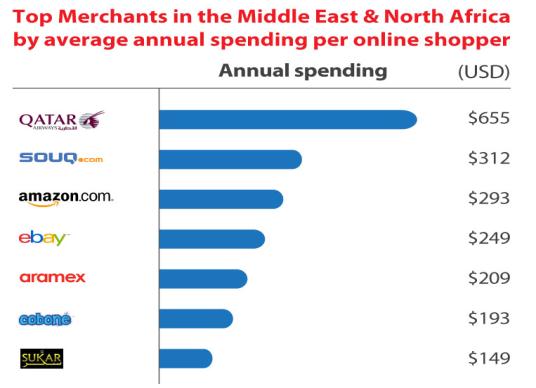
Interestingly, most shoppers find the choice limited in local online stores; hence they prefer cross-border e-commerce, which is growing at more than 70% year-on-year growth. Concierge services such as Shop and Ship from Aramex enable consumers to shop from any international merchant, even ones that do not deliver in the Middle East, so it’s now easier than ever to get products delivered to the region. As a result, most online shopping is done with retailers from the US (35%); Asia (30%) and Europe (25%), the intra-region trade being a mere 10% of the total e-trade.
However, growth this year is being driven by a flood of local retailers coming online and offering local consumers what they could only have found outside the region.


Watsons to open 20 new stores in the GCC
In 2020, global health & beauty retailer AS Watson Group signed its
April 29, 2024 | By Rupkatha BAsda and Deliverect Deepen Partnership to Power Rapid Delivery Across Asda Express
SQUATWOLF’s Kuwait Flagship Store Anchors Its Regional Growth Ambitions
Global beauty icon Ulta Beauty to make Riyadh debut at Panorama Mall
/ 
For decades, Haldiram’s built deep recall across the UAE through its packaged
When House of Habanero opened its first physical location at Alserkal Avenue
Union Coop has completed a significant expansion of its Hatta Souq branch,

Saudi Arabia is set to welcome U.S. food exporters this week, as

Majid Al Futtaim has officially entered the discount retail segment with the

As convenience increasingly becomes currency in the region’s grocery landscape, Union Coop

As wellness becomes a lifestyle in the UAE, the grocery aisle is

Grandiose, one of the leading grocery retailers in the UAE with a

With shifting consumer behaviour, rising cost pressures, regulatory changes, and rapid digitization,

Union Coop’s blend of retail expansion, digital innovation, and community focus is
Abu Dhabi-based MAIR Group has marked a pivotal stage in its transformation

In a move that blurs the line between shopping and investing, Apparel
/ 
Finding the treasure chest of opportunities needs years of journeying through the

How is the food service industry in the Kingdom of Saudi Arabia

The fusion of global and local trends will support the fashion industry

Numerous homegrown brands from the Kingdom of Saudi Arabia are spreading wings

How is the retail industry adapting to rapidly changing consumer behaviour –

While it may not reach the heights of 20-25% penetration, the e-commerce
With coffee being a preferred beverage, the GCC coffee industry has seen

Forty-four percent of TikTok users in the GCC buy something to fit

A frictionless omnichannel experience which is predictive, value-focused, and highly personalised is





 Previous Article