

Insights from ‘2023 Sustainable Commerce’ study conducted by Visa and Emirates Nature-WWF
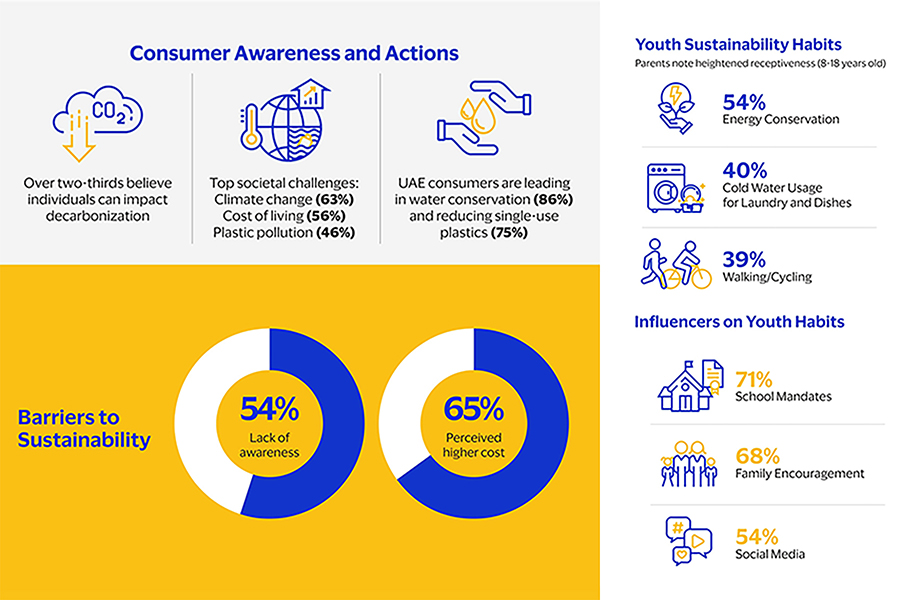
Over two-thirds of consumers in the UAE believe that decarbonisation is not limited to corporate entities, and individuals can make a difference, states the ‘2023 Sustainable Commerce’ study conducted by Visa and Emirates Nature-WWF.
In the UAE, survey respondents view climate change as a leading societal challenge (63%), followed by the rising cost of living (56%) and plastic pollution (46%).
In terms of environmental practices, UAE consumers are leading in water conservation (86%) and rank second in ethical sourcing by supporting local farmer’s market (70%) across the GCC. Additionally, the UAE takes the lead in reducing single-use plastics with a rate of 75%, surpassing the GCC average of 72%.
The UAE shows robust awareness and support for NGOs promoting sustainability (57%), exceeding the GCC average of 53%, and excels in repurposing and sharing products within the community at 72%, compared to the GCC average of 68%.
The study has scrutinised consumer and business behaviours, and the readiness of infrastructure to support sustainable commerce. Importantly, the study found “heightened receptiveness” towards sustainability among the next generation. In the UAE, parents of young consumers (8-18 years old) noted that their children are receptive towards sustainable practices and greater environmental consciousness. Their adopted habits include switching off electrical appliances not in use (54%), washing dishes or laundry with cold water (40%), walking or cycling to places (39%), opting for organic products (36%) and recycling or sharing products (35%).
The primary influencers driving sustainability habits among the youth include school mandates (71%), family members encouraging sustainable behaviours (68%) and social media (54%).
In addition, individuals are also making sustainable choices when it comes to finances. A significant 69% of individuals have expressed their willingness to recommend banks that provide sustainable payment options (cashless/contactless payment). While 64% of consumers stated that they chose a bank with strong green credentials. Moreover, more than half of the surveyed consumers (51%) expect their banks to guide them in making sustainable financial choices. Interestingly, 52% of consumers also look to their banks to help them understand the environmental impact of their purchases.
However, barriers to sustainability exist. A significant one for the majority of UAE consumers (65%) lies in the perceived higher cost of sustainable products, closely followed by a lack of awareness (54%) regarding sustainability. As societal consciousness regarding social and environmental issues expands, the study indicates a rising preference among consumers for businesses that actively demonstrate sustainable practices.
Qualitative interviews conducted for the study revealed that MSMEs and key opinion leaders (KOLs) have a fair understanding of sustainability but lack a holistic and contextual comprehension of the concept. This gap is influenced by several barriers, including cost implications for both businesses and consumers, fear and resistance to change, pressures from competition and profitability and resource constraints. Having said that, there are also enablers that can foster sustainability. These encompass regulatory policies and frameworks that create the right ecosystem, sustainable financing that provides a ‘push’ effect and the necessity for collaboration among stakeholders to drive sustainability. Visionaries, typically medium-sized businesses, grapple with significant pressure from global partners to adopt sustainability standards. However, they are often hindered by a lack of technical knowledge.
On its part, Visa is committed to making a positive impact through local sustainable initiatives, demonstrated by a $250,000 grant to Emirates Nature-WWF. This collaboration aims to co-create and implement science-based projects supporting local nature and wildlife preservation, climate action, market transformation, the green economy and food and water security in the UAE.



Watsons to open 20 new stores in the GCC
In 2020, global health & beauty retailer AS Watson Group signed its
April 29, 2024 | By Rupkatha BAsda and Deliverect Deepen Partnership to Power Rapid Delivery Across Asda Express
SQUATWOLF’s Kuwait Flagship Store Anchors Its Regional Growth Ambitions
Global beauty icon Ulta Beauty to make Riyadh debut at Panorama Mall
/ 
For decades, Haldiram’s built deep recall across the UAE through its packaged

When House of Habanero opened its first physical location at Alserkal Avenue
Union Coop has completed a significant expansion of its Hatta Souq branch,

Saudi Arabia is set to welcome U.S. food exporters this week, as

Majid Al Futtaim has officially entered the discount retail segment with the

As convenience increasingly becomes currency in the region’s grocery landscape, Union Coop

As wellness becomes a lifestyle in the UAE, the grocery aisle is

Grandiose, one of the leading grocery retailers in the UAE with a

With shifting consumer behaviour, rising cost pressures, regulatory changes, and rapid digitization,

Union Coop’s blend of retail expansion, digital innovation, and community focus is
Abu Dhabi-based MAIR Group has marked a pivotal stage in its transformation

In a move that blurs the line between shopping and investing, Apparel
/ 
‘Landmark Circulife’ aims to transform used fabric into valuable recycled fibres to be reused in new products.

During her SOLOx session at the IMAGES RetailME Awards 2024, Mrunal Khimji,

From being one of the first retailers in Dubai to ban single-use

Founded in 2007 by Kim Thompson and Matt Toogood, UAE-based RAW Coffee

Aligned with the principles of ‘slow fashion’ UAE-based homegrown brand Ryokō Bags

US-based company SAMBAZON, an acronym for ‘Sustainable Management of the Brazilian Amazon’,

Kuwait-headquartered regional retail conglomerate Alshaya Group’s sustainability strategy is centred around three

Emirati Gen Z women are seeking collaborative, culturally diverse and creatively enriching

Almost 70% of MENA-based organisations claim to have bold sustainability ambitions with

UAE-based diversified business GMG launched its sustainability report sharing insights on its

From ethical and local sourcing to adopting cutting-edge technologies to curb food





 Previous Article